
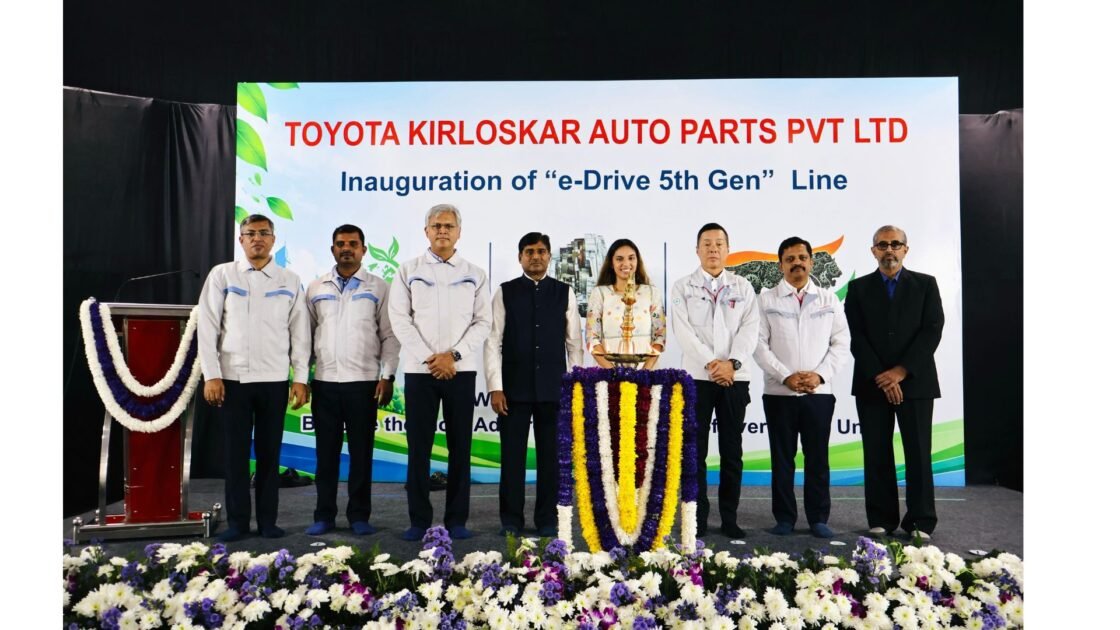
The new manufacturing line at TKAP’s Bidadi facility will add an annual production capacity of 2 lakh E-Drive units, taking its total capacity to 3.6 lakh units.
Toyota Kirloskar Auto Parts Pvt. Ltd. (TKAP) has inaugurated a new E-Drive manufacturing line at its Bidadi facility in Bengaluru, Karnataka, following an investment of approximately Rs 460 crore. The facility will manufacture next-generation products registered under the Government of India’s Advanced Automotive Technology (AAT) Production Linked Incentive (PLI) scheme, marking another step towards localising advanced electrified powertrain technologies in India.
The new production line was inaugurated on November 16, 2026, by Dr S. Selvakumar, Principal Secretary, Commerce and Industries Department, Government of Karnataka. The event was attended by Manasi Tata, Vice Chairperson of Toyota Kirloskar Motor, and Tabrez Ahmed, Managing Director of Toyota Kirloskar Auto Parts, along with other company executives.
TKAP’s E-Drive Production Capacity Increases
The new manufacturing line adds an annual production capacity of 2 lakh units. With this addition, TKAP’s total E-Drive production capacity has increased to 3.6 lakh units per year.
The facility will operate alongside the company’s existing fourth-generation E-Drive manufacturing line, which was commissioned in 2022. Together, the two production lines are expected to strengthen domestic manufacturing capabilities for electrified powertrain components.
According to the company, the investment is aimed at reducing dependence on imports while expanding India’s capabilities in advanced mobility technologies. The additional capacity is also expected to support the growing adoption of hybrid electric vehicles in the country.
Part Of Toyota Group’s Rs 4,800 Crore Karnataka MoU
The project is part of a Rs 4,800 crore Memorandum of Understanding signed between Toyota Group companies and the Government of Karnataka. The agreement focuses on promoting advanced manufacturing, localisation, employment generation and green mobility technologies in the state.
The new line also supports the Centre’s Make in India initiative and its objective of increasing self-reliance in automotive technologies through domestic value creation and a stronger supplier ecosystem.
E-Drive is a key component of Toyota’s hybrid electric vehicle technology and is classified as an Advanced Automotive Technology under the government’s PLI scheme for automobiles and auto components. Manufacturing the system requires specialised production processes, automation, stringent quality standards and a capable local supply chain.
Toyota’s Hybrid Technology Strategy In India
Speaking at the inauguration, Manasi Tata said the new line represents an important milestone in Toyota’s efforts to localise advanced electrified technologies. She added that expanding domestic production of next-generation hybrid systems would strengthen India’s automotive value chain and support the country’s electrification journey.
Tabrez Ahmed said the facility builds on the foundation of the existing fourth-generation manufacturing line. He highlighted the role of local production in developing the supplier ecosystem and creating a skilled workforce.
Toyota stated that it has sold more than 36.8 million hybrid vehicles globally. In India, Toyota Kirloskar Motor was among the early manufacturers to introduce Self-Charging Hybrid Electric Vehicle (SHEV) technology, which combines a petrol engine with an electric motor.
The company claims that its SHEV technology can deliver 35–50 per cent better fuel efficiency and lower carbon emissions without requiring external charging or changes in driving behaviour.
Toyota plans to continue expanding its electrified and alternative-energy vehicle portfolio under its multi-pathway strategy, with greater localisation and manufacturing capabilities forming an important part of its approach.